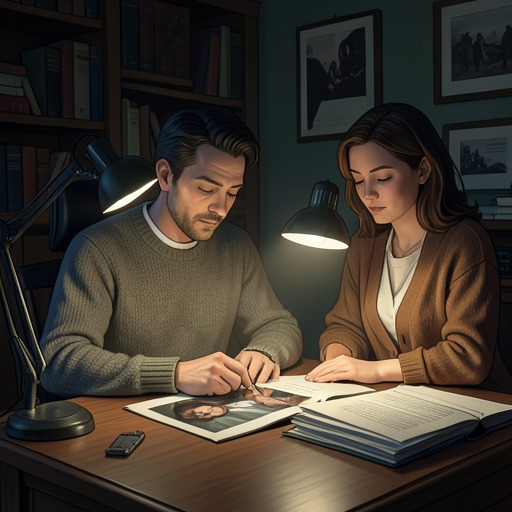
Shay and Rudek Nowack
The Edge of the WorldShay and Rudek Nowack are father and son, but the relationship reaches Shay not through shared memories or a living bond: he learns it from a headstone and the records Ollie has gathered. The discovery gives a familiar surname an unexpected meaning, then makes Shay reckon with the crime and prison death that define what he knows of his father. Because Ollie is both investigating Shay’s family history and filming the tour, this private revelation unfolds within a documentary project whose boundaries Shay is still learning to understand.
A relationship discovered through research
Before Shay knows Rudek’s identity, the investigation has already raised questions about who its subject is and what information the camera may carry beyond the tour. Corina Hussain presents Shay with a nondisclosure agreement between him and Sky, explaining that it means the researcher will not report what he sees on tour. She also tells Shay that the researcher is joining the tour to film a documentary as it happens. The agreement concerns reporting from the tour; the evidence does not establish that it settles every question of consent or privacy raised by the later family revelation.
Ollie eventually makes clear that the project is not a study of Shay’s adoptive family: he is researching Shay himself. For Shay, that distinction changes the apparent subject of Ollie’s work. The research is personal in a way he had not understood, and the disclosure leaves him with little time to respond before he is called away. The relationship with Rudek therefore enters the story through an investigation whose purpose Shay initially misunderstands, rather than through an established account of father and son knowing one another.
The name on the headstone
At the grave, Shay studies a sparse headstone bearing Rudek Nowack’s name and the dates 1966–1998. The name is what first catches his attention: Nowack is Shay’s name too. Shay wonders whether this points to the Danish side of his family, through his mother. Ollie corrects that assumption, explaining that relatives on both sides having variations of the name is coincidental. A shared surname may prompt the question, but it does not itself explain the connection.
The dates deepen the question. Shay reads the name and dates again, then asks who Rudek was. Ollie tells him that Rudek was his father. The revelation gives the grave its decisive meaning: what looked like a discovery about a name becomes proof of a direct family relationship. Rudek is already dead, so Shay encounters him through the grave, Ollie’s account, and documentary evidence rather than through a present-day exchange between father and son.
Ollie recognizes that the history is difficult and offers to turn the camera off or take Shay somewhere else. Shay says he wants to know. That response establishes his choice to continue at this point, without making the news easier or undoing the unevenness of the situation: Ollie has already assembled the family history, while Shay is receiving its most consequential fact in the moment. Ollie guides him away from the grave to a nearby bench and gives him a newspaper report, shifting the disclosure from the identity on the stone to the events behind Rudek’s death.
The crime and its aftermath
The report concerns Ava Martin, who went missing in 1997 on her way home from work; her body was found three days later on Hawksworth Moor. Ollie tells Shay that her ex-boyfriend murdered her. Shay asks whether the killer was his father, and Ollie confirms that he was. He then explains that Rudek was tried and convicted, received a life sentence, and died by suicide in Wakefield Prison not long afterward. The grave’s dates, the report, the conviction, and the prison death form the record through which Shay can piece together the father he never knew from the evidence presented here.
Ollie qualifies the account rather than presenting every detail of Rudek’s conduct as equally certain. From what he understands, the killing was not premeditated. He also reports that Rudek had multiple convictions for petty violence and drug offences, and that Ava had reported him for domestic violence more than once without charges being filed. These details situate the murder within a history of reported abuse and prior offending, while Ollie’s qualification preserves a distinction between what the investigation indicates about the killing and what it establishes about Rudek’s record.
Shay asks whether Ava was his mother; Ollie says she was not. That clarification separates the murdered woman in the report from Shay’s own maternal history. The evidence thus reveals both a connection and a limit: Ava’s death is central to understanding why Rudek was imprisoned, but she was not Shay’s mother. The relationship between father and son is disclosed alongside a separate history of violence that Shay must not confuse with his own immediate family line.
Paternity, knowledge, and the camera
The scene gives paternity a starkly documentary form. A name on stone leads to a question; Ollie answers it, then produces a newspaper report to substantiate the history. Shay’s knowledge arrives in stages—surname, dates, fatherhood, murder, conviction, death—and each stage revises the meaning of the one before it. The grave does not offer a personal account of Rudek: its sparse inscription contains no messages or prayers, and the surrounding explanation comes from Ollie and the records he brings.
Filming is part of this disclosure, but the evidence distinguishes between recording a conversation and deciding what belongs in the documentary. Earlier, when Shay asks whether the material Ollie has just explained will be included, Ollie says he will edit it out and proposes starting the camera for a conversation. At the grave, he again offers to switch the camera off before telling Shay more. These moments show Ollie acknowledging that the investigation’s revelations need not automatically become film content; they do not establish precisely what was ultimately recorded or published. Shay’s relationship with Rudek is consequently shaped not only by what the research reveals, but by the question of how a deeply personal discovery is handled while a camera is present.